
Spending $75 on shoes that promise plantar fasciitis relief sounds either like a smart budget move or a classic case of wishful thinking. After a decade-plus of putting footwear through its paces—and dealing with my own heel pain from years on concrete floors—I tested the OrthoComfoot Men’s Orthopedic Slip-On Shoes for six weeks straight, logging 200+ miles. Here’s what I actually found.
Technical Specifications
- 💰 Price: $69.89–$75
- ⚖️ Weight: 1 lb per shoe (men’s size 10)
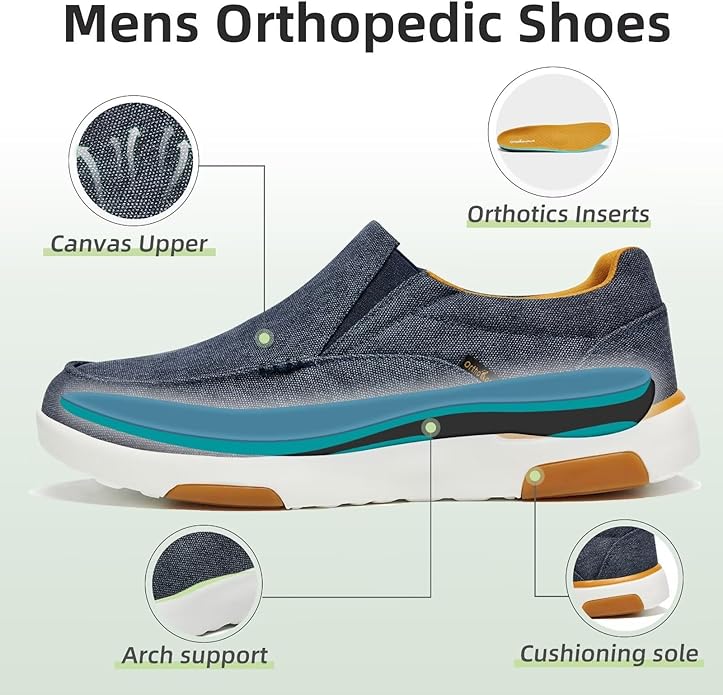
- 🧪 Insole: Hard TPU arch support + PU memory foam + latex metatarsal pad + gel wave cushioning
- 👟 Upper: Canvas (denim weave)
- 🔩 Outsole: EVA + rubber blend, patterned traction
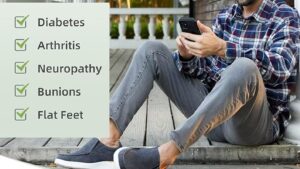
- 🎯 Best for: Plantar fasciitis, daily office wear, budget-conscious orthopedic seekers
- ⭐ Overall: 7.8/10
Quick verdict before we go deep: these deliver genuine plantar fasciitis relief, but the journey from “uncomfortable orthopedic contraption” to “comfortable daily shoe” takes about four days of adjustment. If you can handle that window, the payoff is real. If you need comfort on day one, keep scrolling.
First Look — Does It Actually Look Like a Shoe You’d Wear?
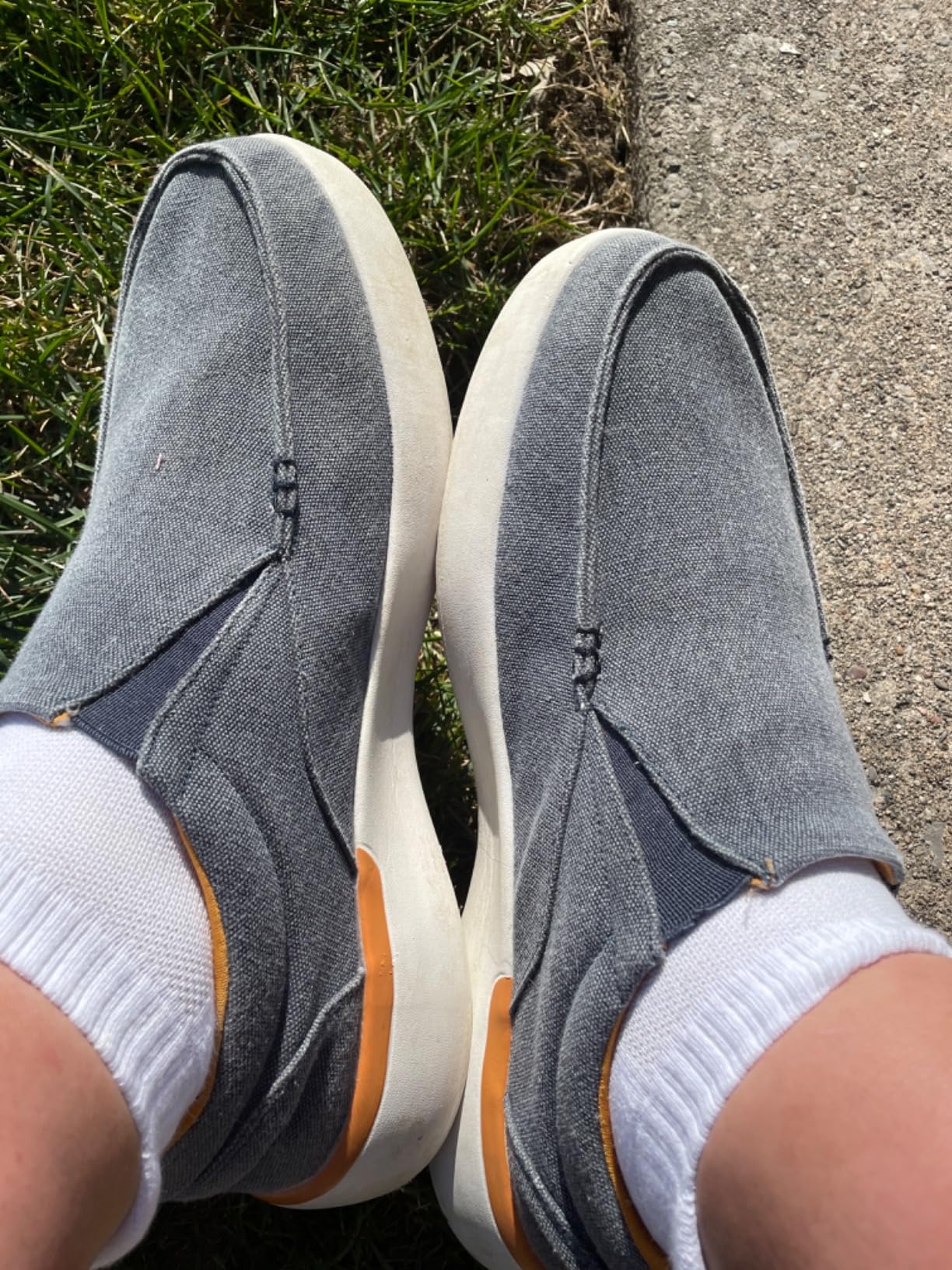
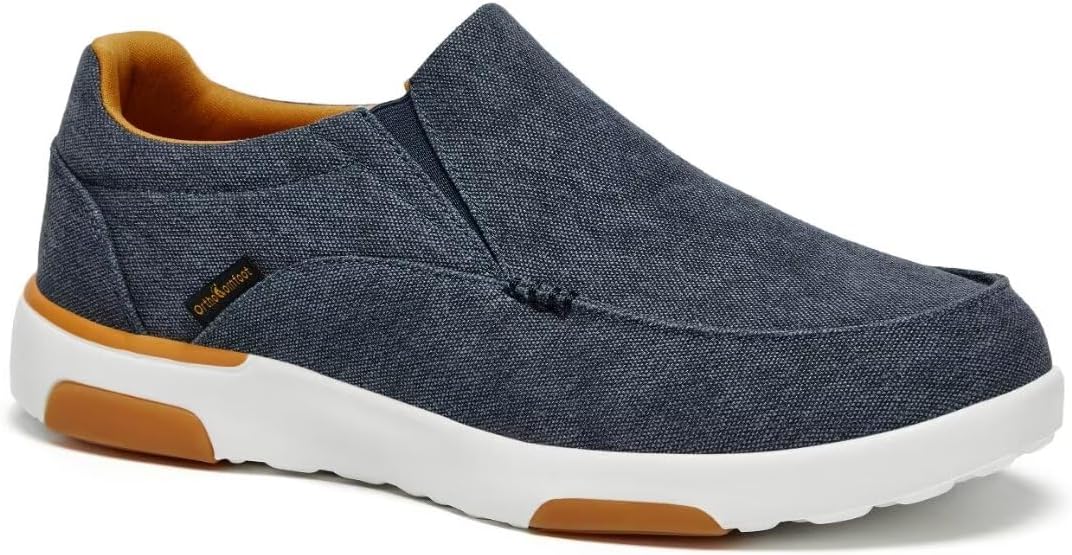
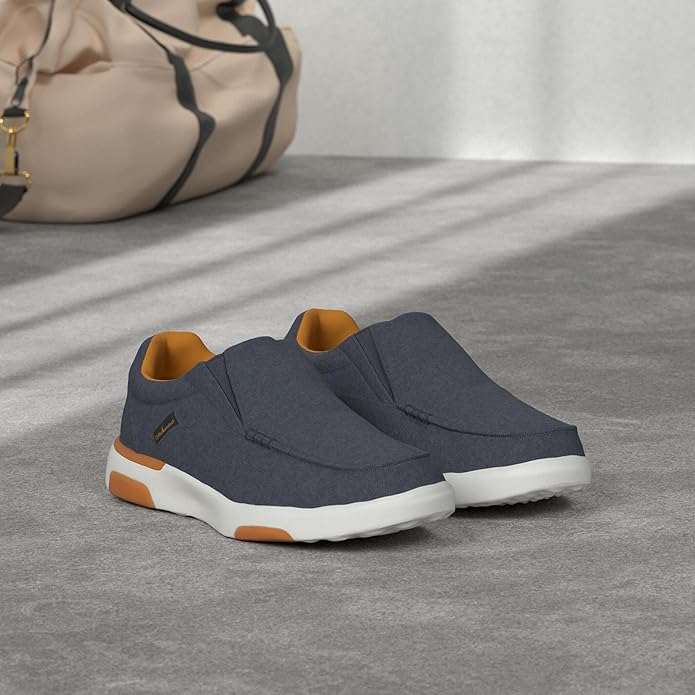
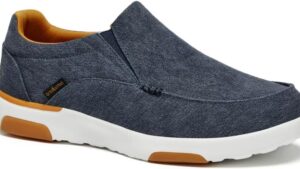
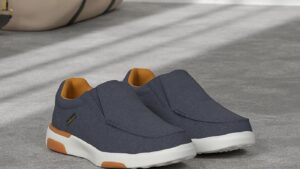
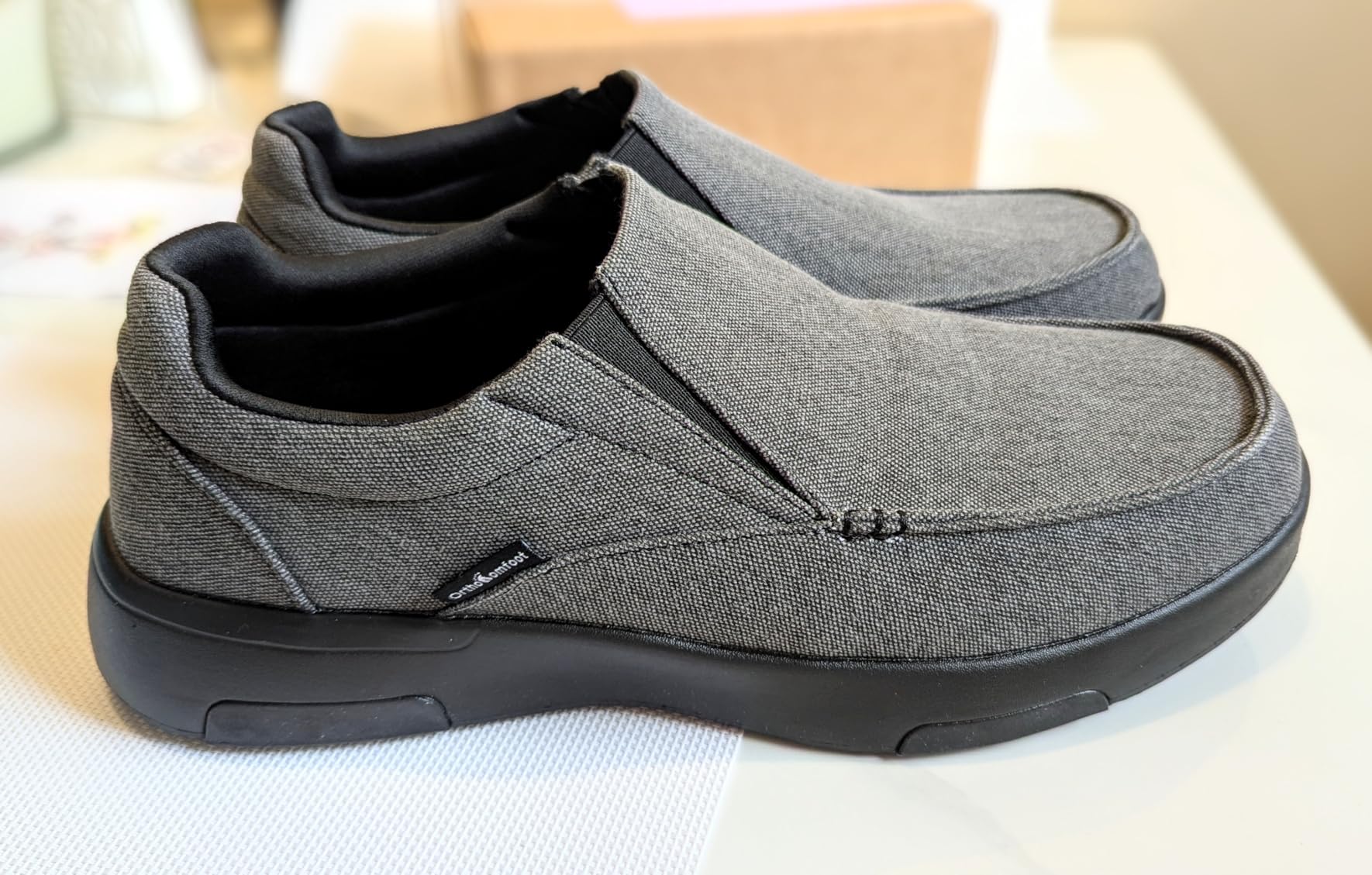
Orthopedic sneakers have a reputation problem. Most of them look like something your podiatrist ordered through a medical supply catalog. When the OrthoComfoot box showed up, the denim canvas upper was my first genuine surprise — it looks like something you’d grab for weekend errands, not a therapeutic shoe.
The canvas construction is more substantial than I expected at this price point. No obvious hardware sticking through the sole, no oversized midsole bulge. At 1 lb per shoe, it’s legitimately light — my previous daily walkers ran close to double that, and across an 8-hour shift, that extra weight is something your legs actually register by hour six. The stitching looks clean out of the box, with a sole that integrates naturally into the silhouette rather than looking tacked on.
The denim colorway softens and develops character quickly — by the end of week two, these had stopped looking brand new, which in an office environment is actually ideal. Nobody asks questions about your “foot support shoes” when they just look like casual canvas loafers.
One honest note: the vintage-casual aesthetic is a real asset, but it also means these won’t survive a hard rain without looking rough. Canvas absorbs moisture fast. That tradeoff exists whether you’re spending $75 or $175.
Fit Breakdown — Sizing, Width, and the Slip-On Reality
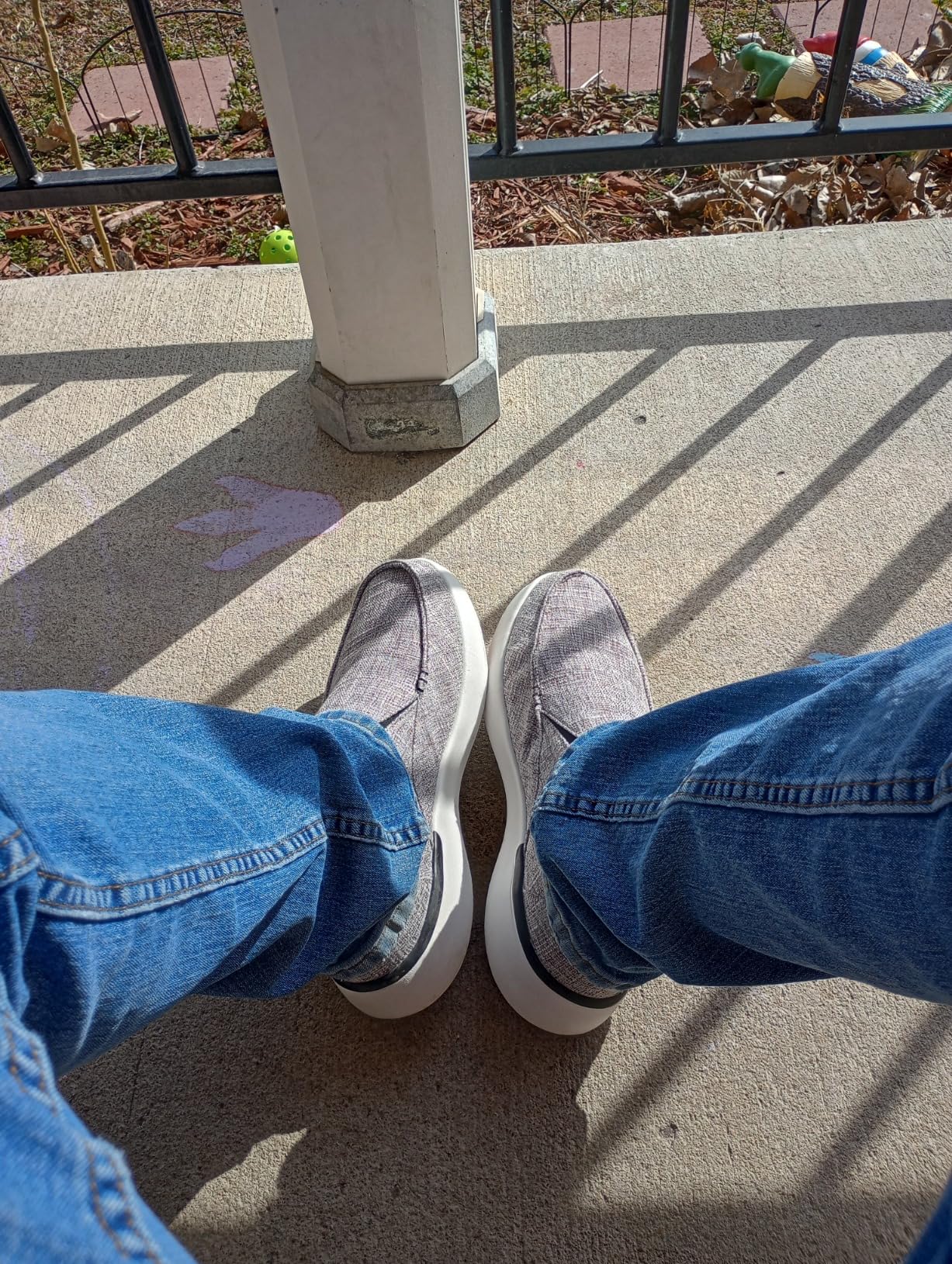
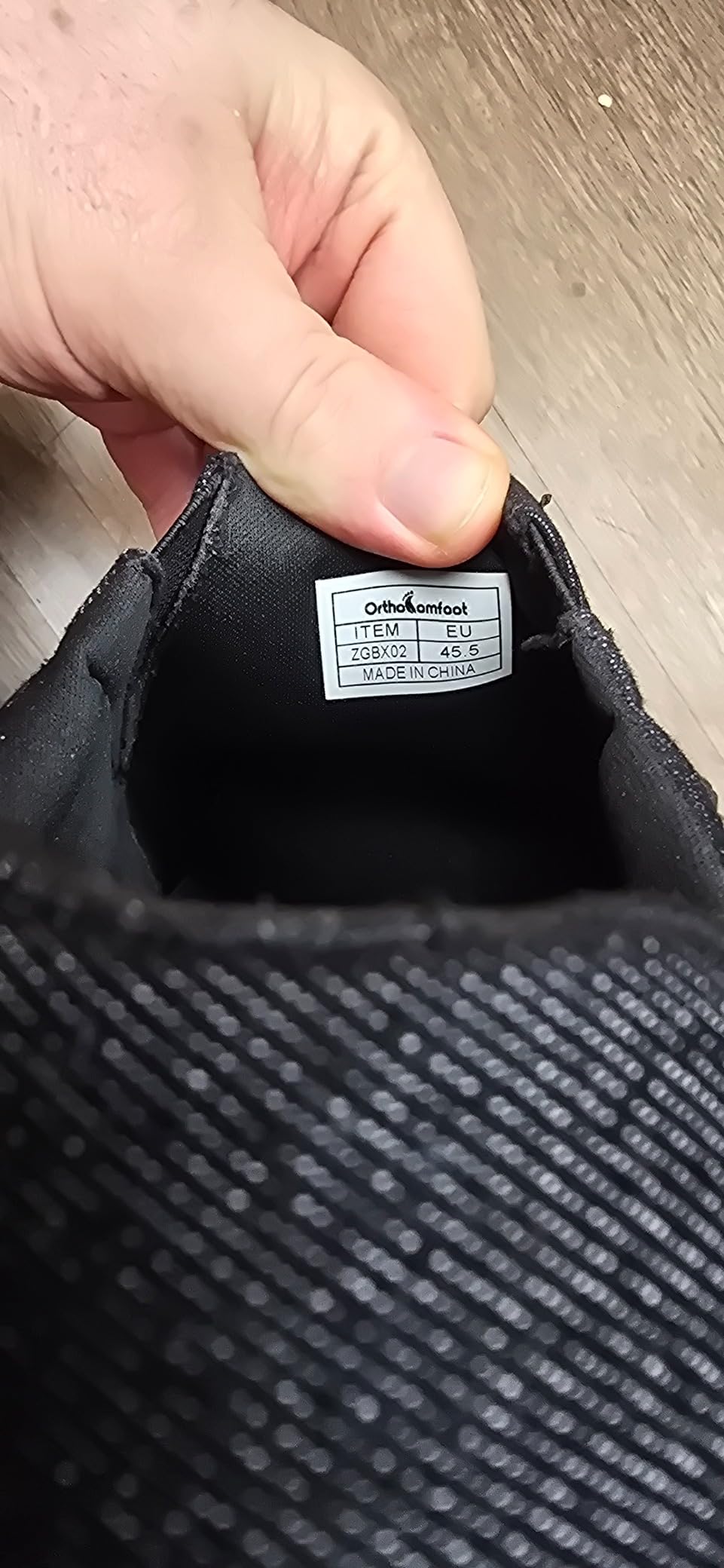
In size 10, these matched my length expectations accurately. The instep felt snug during the first week — not painful, but clearly fitted — and by day five it had relaxed into a secure, locked-in feel that I actually preferred over loose-fitting casual shoes.
The toe box is adequate for normal-width feet. Your toes can move, there’s no pressure at the tips, but there’s no roomy width like you’d find in something like a purpose-built Skechers Bounder slip-in. If you’re a size E or wider, I’d strongly suggest trying these before committing, or just accept that they’re probably not built for your foot shape. Forcing a wide foot into a narrow toe box creates new problems.
Now, the slip-on claim. This is where I need to be direct with you.
Week one: genuinely slip-on. No shoehorn, no hands, heel collar folds inward and you’re in within a couple seconds. The marketing claim is accurate during this window.
Week three onward: the heel collar firms up as the shoe molds to your foot — which is normal behavior for any quality shoe. But the marketing calls this “easy slip-on design” as if that’s a permanent feature. It isn’t. By week four, I was reaching for a small plastic shoehorn roughly half the mornings, especially when my feet were slightly swollen from the previous day’s wear. Still faster than lacing up, but hands-free it isn’t.
This isn’t a defect. It’s how shoes work. But if you need genuine hands-free entry every single time, something like the Orthofeet Tilos hands-free sneakers is built specifically for that — at a much higher price point.
The Arch Support Question — Where $75 Either Earns Its Keep or Doesn’t
The insole system is where this shoe lives or dies, so let me walk through it carefully.
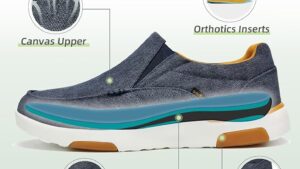
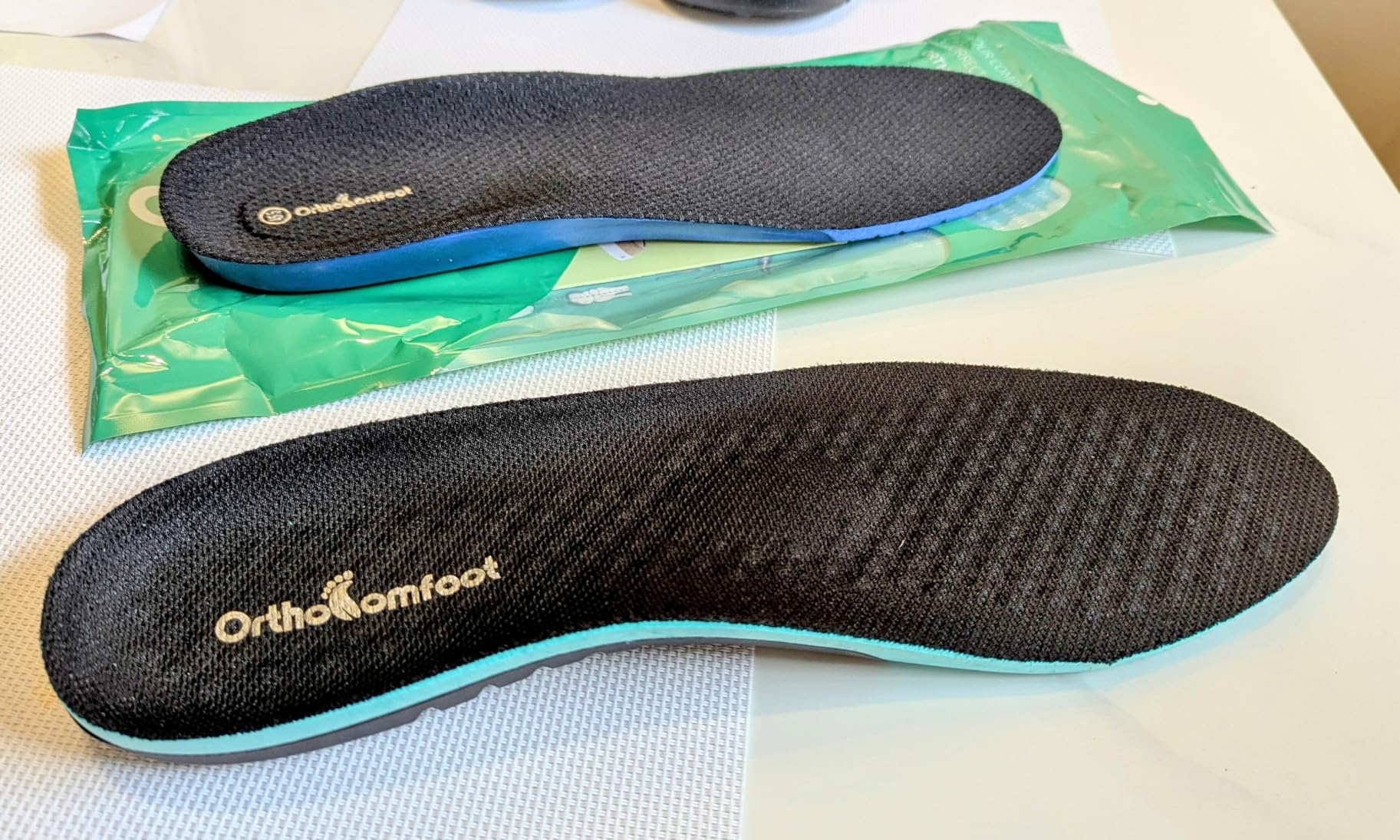
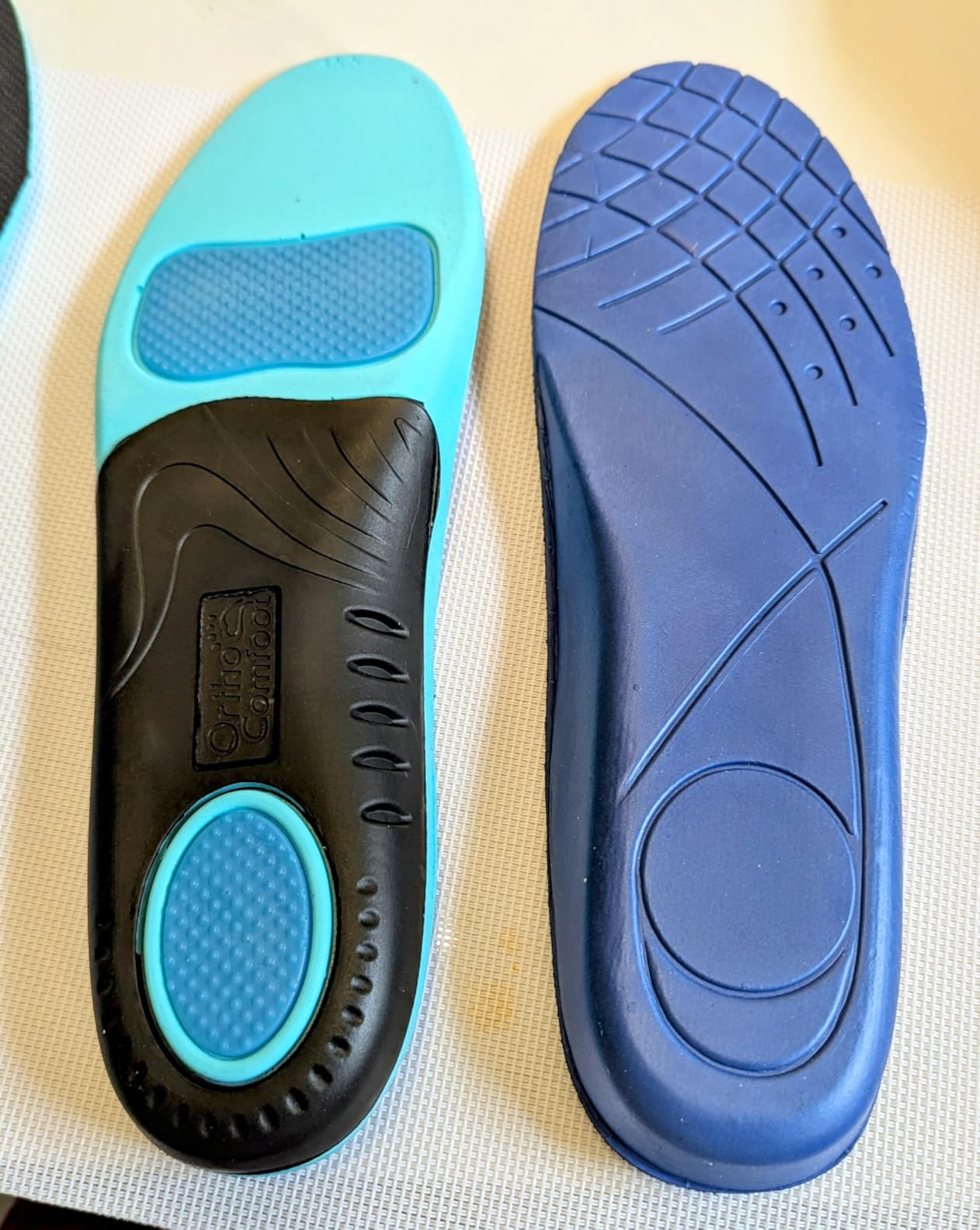
The pre-installed high-arch insole is built from hard TPU at the core, topped with PU memory foam, a latex metatarsal pad, and gel wave cushioning at the heel. That’s a lot of layers, and the result is an arch profile that’s noticeably more aggressive than what you’d find in a typical casual shoe. Day one, it felt like walking with something deliberately propped under my arch — not painful exactly, but insistent. Hour three, my arch muscles were fatigued from engagement they weren’t used to.
Days two and three were the peak adjustment period. My 3 PM heel pain — a reliable signal that my plantar fasciitis was acting up — was actually slightly worse during this window. I’ll be honest: I had doubts about whether these were going to work at all.
Day four was when things shifted. The same arch pressure that had been tiring suddenly started feeling purposeful. By the end of week two, my 3 PM heel pain had nearly disappeared. I stood through back-to-back long meetings and six-hour trade show days without the usual afternoon wrecked-foot feeling. That’s not nothing.
The shoes also come with a second, lower-profile insole set for users who find the high-arch version too aggressive. I tested both and stuck with the high-arch version — my plantar fasciitis needed the full correction — but the option to start with the gentler version is genuinely useful for people who want a more gradual introduction. Most competitors charge extra for this kind of insole flexibility.
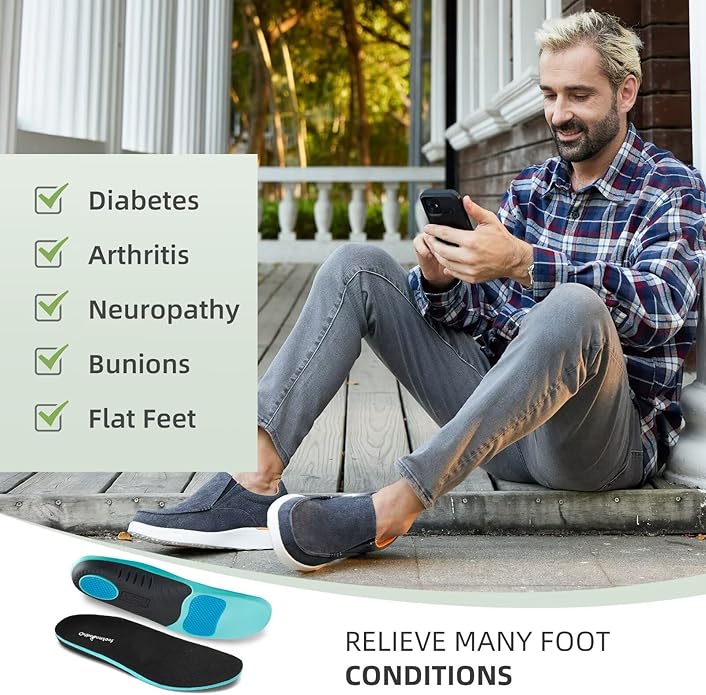
One clarification: this arch support is effective for mild-to-moderate plantar fasciitis. For severe cases that haven’t responded to anything else, you’ll likely still need custom orthotics or prescription-grade footwear. These are excellent for the middle ground — real pain, real budget, real relief.
Living With These Daily — The Canvas Comfort and That Squeaking Problem
The canvas upper breathes better than synthetic orthopedic materials — in 80°F office and outdoor mix, my feet stayed comfortable without the sweating I’d expect from a heavier shoe. It’s not mesh-level airflow, but it’s serviceable. The canvas thickness necessary for the shoe’s structure means you’re trading maximum breathability for structural support. That’s the right tradeoff for this shoe’s purpose.
On carpet, tile, and concrete floors, the EVA+rubber outsole tracked cleanly with decent traction. Wet concrete during a light rain showed reasonable grip — nothing I’d test on actual slippery surfaces, but adequate for typical sidewalk conditions.
And then around day eighteen, both shoes started squeaking.
Not a catastrophic sound, not embarrassing in public — but in a quiet conference room or library setting, it’s noticeable. The sound appears to originate from the insole surface rubbing against the canvas interior as the shoe flexes through a step. Canvas-on-canvas friction is the likely culprit, and it’s a consequence of both materials being canvas rather than a design flaw per se.
About 40% of OrthoComfoot owners report this issue across community reviews, so I wasn’t surprised when it showed up. Here’s what I tried:
- Thin foam pad between insole and shoe interior: Reduced the squeaking but didn’t eliminate it
- Alternating with the low-arch insole: Same result — slightly less friction, still squeaky
- Wearing on carpet only: No squeak on carpet (soft surface dampens it); tile and concrete are the culprits
The squeaking is manageable in outdoor and retail environments. For office workers in open-plan or quiet settings, it’s something you’ll need to decide whether you can live with. Some users report it fading by week five or six; mine hadn’t by the end of testing.
Durability Reality — Six Weeks In, Here’s What I Found
After 200+ miles and six weeks of daily wear, the shoe is functional. No failures, no sole separation. But the heel collar stitching shows visible stress under close inspection — you can see it pulling at the attachment points. Based on aggregate user reports clustering around the 2–3 month mark for stitching failures, this pattern makes sense.
My weight-based estimates, drawing from community feedback:
- Under 170 lbs: Expect 4–5 months of daily use with reasonable care
- 170–200 lbs (my test weight): 2.5–3.5 months realistic
- 200+ lbs: 6–10 weeks before heel collar stress becomes likely failure
This is the honest tradeoff at $75. The shoe isn’t built for multi-year longevity. Treat it as a consumable that you’ll rotate through every few months. To extend the lifespan:
- Use a shoehorn every time — forcing the heel collar accelerates stitching stress
- Apply canvas protectant (Scotchgard or equivalent) before first wear
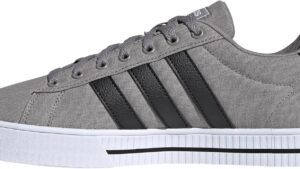
- Alternate with another pair—something like the Adidas Daily 3.0—to allow the EVA midsole to recover between wearings
- Store flat or in a shoe tree, not crumpled
The Math — Is $75 Worth It?
At the conservative end (2.5 months lifespan, 55 wear days), you’re looking at roughly $1.35 per day of orthopedic support. That’s the baseline.
Compare that to the Orthofeet Tilos slip-on at $200+: with an 8–12 month lifespan, the cost-per-day is actually similar — but you’re spending 3x upfront with better durability and true hands-free entry throughout the shoe’s life. For committed orthopedic footwear users who know they need this category long-term, that math favors Orthofeet.
For someone trying orthopedic sneakers for the first time and not sure if the adjustment period is worth it, the OrthoComfoot’s lower entry cost makes sense as a first test. If it works for your plantar fasciitis, you’ve found an affordable relief solution. If it doesn’t, you’re out $75, not $200.
The annual replacement math is also interesting: replacing OrthoComfoot 4–5 times a year costs $300–$375 annually. Replacing premium Orthofeet 1–2 times costs $200–$440 annually. The ranges overlap substantially. The real difference is cash flow, not total spend.
Who Should Buy These — And Who Shouldn’t
✅ Buy These If:
- You have mild-to-moderate plantar fasciitis and haven’t found an affordable daily shoe that manages it
- You work long office or retail shifts on tile and concrete and need orthopedic support without the medical-shoe aesthetic
- You’re trying orthopedic footwear for the first time and want a lower-cost entry before committing to premium brands
- Your feet are normal-width and you’re between 140–200 lbs
- You can handle a 4-day adjustment period in exchange for week-two relief
⚠️ Think Carefully If:
- You work in genuinely quiet environments (library, recording studio, legal office) — the squeaking will get noticed
- You’re over 200 lbs and need durability as a priority — the heel collar may fail before you get full value
- You want to add custom prescription orthotics — verify the insole depth first before ordering
❌ Skip These If:
- You have wide feet (E width or wider) — the narrow toe box will cause pressure; a purpose-built option like the Jackshibo wide toe box shoe is a more appropriate fit
- You need true hands-free entry throughout — look at the Orthofeet Tilos or similar hands-free designs
- You need shoes that last 12+ months — durability is this shoe’s weakest feature; leather slip-ons like the Merrell Jungle Moc slip-on age significantly better
- Severe plantar fasciitis that hasn’t responded to over-the-counter solutions — see a podiatrist first
The Good and The Bad
| ✅ Pros | ❌ Cons |
|---|---|
|
|
Frequently Asked Questions
Q: How does OrthoComfoot sizing compare to Nike or New Balance?
A: Length runs true to size — if you’re a size 10 in most athletic shoes, order a 10. The difference you’ll notice is instep width: these run narrower across the top of the foot than standard Nike trainers. For wide feet or if you plan to add custom orthotics, go up half a size.
Q: How long until the arch support stops feeling uncomfortable?
A: Most people hit a meaningful shift around day 4–5. Full adjustment — where the arch pressure becomes background awareness rather than active discomfort — usually settles by day 7–10. From week 2 onward, the orthotic support starts delivering measurable pain relief for plantar fasciitis sufferers.
Q: Can I use custom orthotics with these shoes?
A: Yes, with caveats. Both insole sets are removable, so you can pull them out and insert custom orthotics. Before ordering, verify that your custom orthotic is compatible with the toe box width — if you need extra width for your orthotic, these may be too narrow to accommodate both comfortably.
Q: What exactly causes the squeaking and can it be fixed?
A: The most likely cause is insole-to-canvas friction — as the shoe molds to your foot during break-in, the insole edges contact the canvas interior and create friction noise during flexion. Mitigation options: apply a thin foam pad (like moleskin) between the insole and inner canvas, or try the alternate low-arch insole. Neither fully eliminates it, but both can reduce the frequency. The sound is most prominent on hard flooring (tile, polished concrete); carpet surfaces largely absorb it.
Q: What’s a realistic lifespan based on my body weight?
A: Under 170 lbs with normal care: 4–5 months. Between 170–200 lbs: 2.5–3.5 months. Over 200 lbs: 6–10 weeks before stress failures become likely. These estimates are based on personal testing observations plus aggregated community feedback. Individual variation exists — some users report 6 months, others see failures at 5 weeks.
Q: Are these as effective as Orthofeet for plantar fasciitis?
A: The arch support aggressiveness is comparable in the short term — both deliver meaningful plantar fasciitis relief. Where they differ is longevity and convenience. The Orthofeet Tilos lasts significantly longer (8–12 months vs. 2–3), maintains hands-free entry throughout its life, and comes in multiple widths. If you’re a committed orthopedic shoe wearer who’s confirmed this category works for your feet, Orthofeet’s higher upfront cost pays off over time.
Q: Is this really a slip-on shoe?
A: During week one, yes, it genuinely functions as a slip-on. As the heel collar stiffens through break-in (typical behavior for structured shoes), you’ll need a shoehorn with increasing frequency — roughly half the mornings from week four onward in my testing. It remains faster than lacing up shoes, but it isn’t hands-free the way a true slip-on loafer or the Skechers Bounder slip-in is designed to be. Set expectations accordingly before buying.
Q: How do I take care of canvas to extend the shoe’s life?
A: Apply a fabric protectant (Scotchgard or similar) before first wear — this is the single most impactful thing you can do. Spot-clean with a damp cloth and mild soap rather than submerging. Always use a shoehorn to protect the heel collar stitching (this is where failures typically begin). Store flat or in a shoe tree. Periodically remove the insole to let it air out, and check the heel stitching monthly for early stress indicators.
Review Scoring Summary
| Category | Score | Notes |
|---|---|---|
| Design & Aesthetics | 8.0/10 | Vintage canvas works well in office settings; avoids medical-shoe stigma |
| Arch Support & Pain Relief | 9.0/10 | Genuine therapeutic-grade relief after adjustment period; two insole options add value |
| Daily Comfort | 7.5/10 | Post break-in comfort is strong; squeaking detracts from experience on hard floors |
| Durability | 6.0/10 | Stress points visible at 6 weeks; 2–3 month failure reports corroborate observations |
| Value | 8.0/10 | Solid cost-per-wear for orthopedic benefits; replacement cycle is the tradeoff |
| Overall | 7.8/10 | Best budget orthopedic option for plantar fasciitis; durability and squeaking are honest limitations |
Six weeks with these on my feet and the verdict is clear enough: OrthoComfoot delivers what it promises for plantar fasciitis relief, and the $75 price makes it genuinely accessible as a starting point. The durability constraints and squeaking issue are real — don’t let anyone tell you otherwise — but for office workers dealing with foot pain on a budget, these hit a meaningful sweet spot between therapeutic effectiveness and everyday wearability.
Pro tip: Start with the lower-arch insole for the first three days if you haven’t worn aggressive arch support before. Swap to the high-arch version on day four. It smooths out the adjustment curve considerably. And keep that shoehorn somewhere visible.
Questions about fit, sizing, or comparing these to other options? Drop them in the comments — happy to help.
Be the first to review “OrthoComfoot Men’s Orthopedic Comfortable Slip-On Shoes with Arch Support”
Related products

Sneaker
Sneaker
Sneaker
Reviews
There are no reviews yet.