
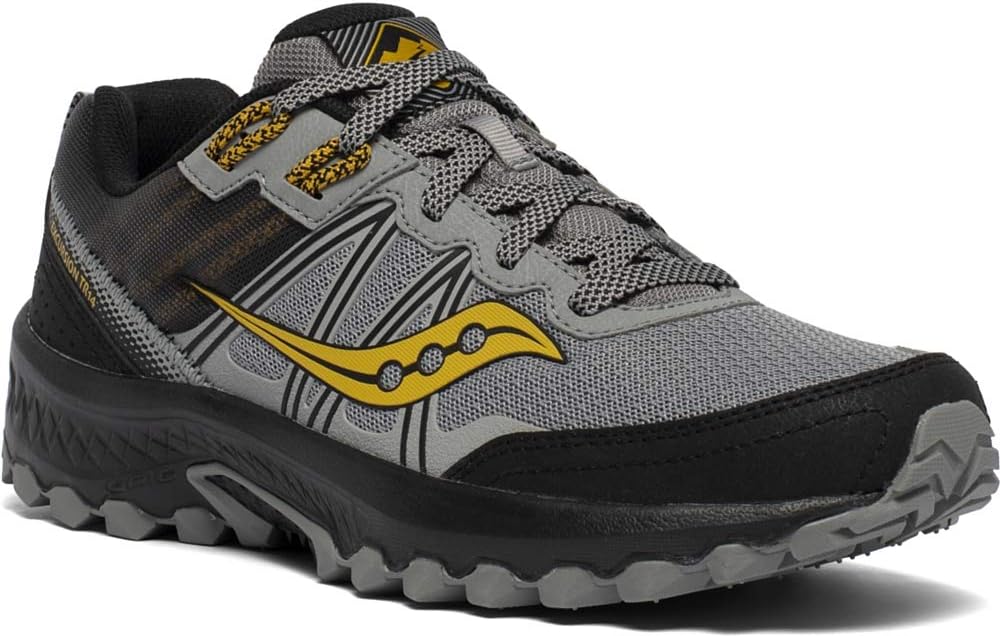
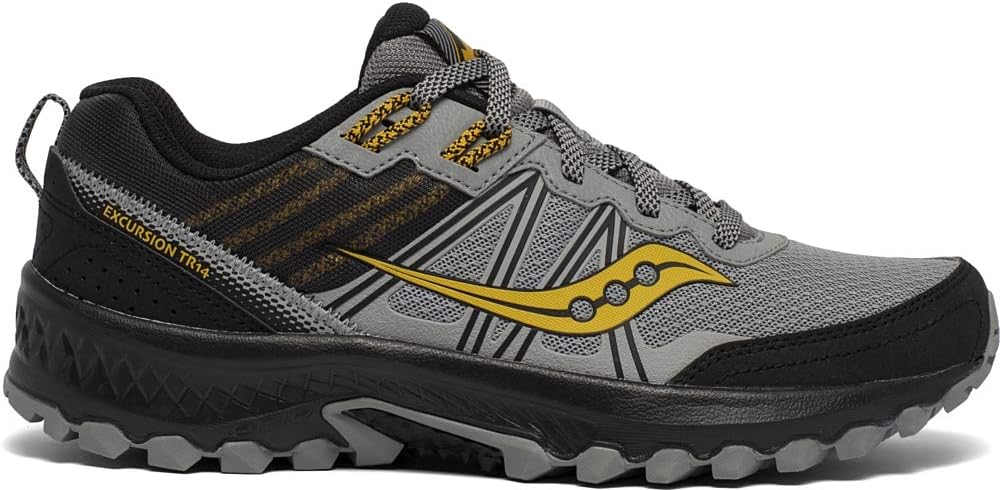
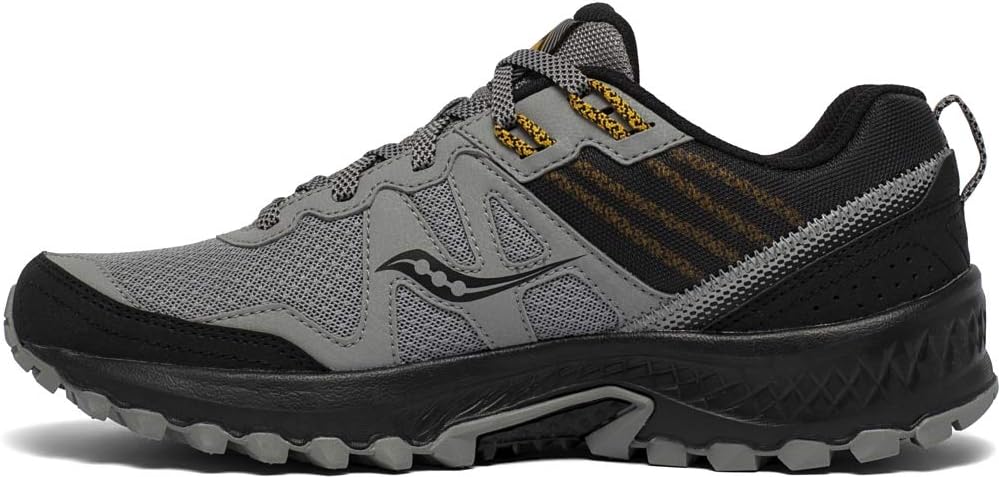
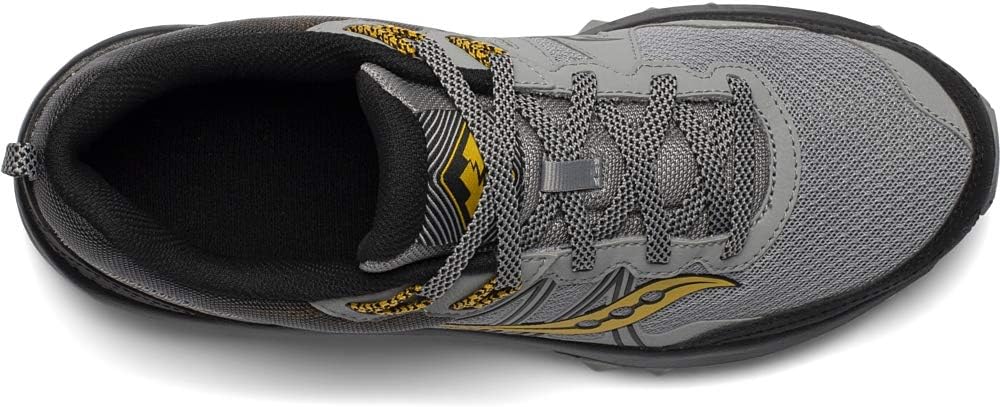
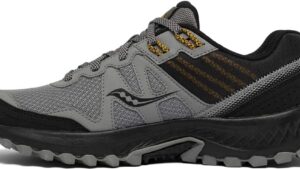
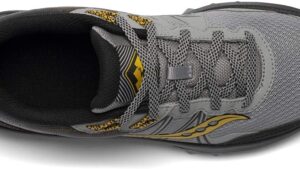
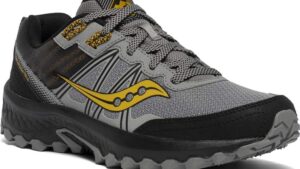
- Model: Saucony Men’s Excursion TR14
- Category: Trail running / light hiking & daily walking
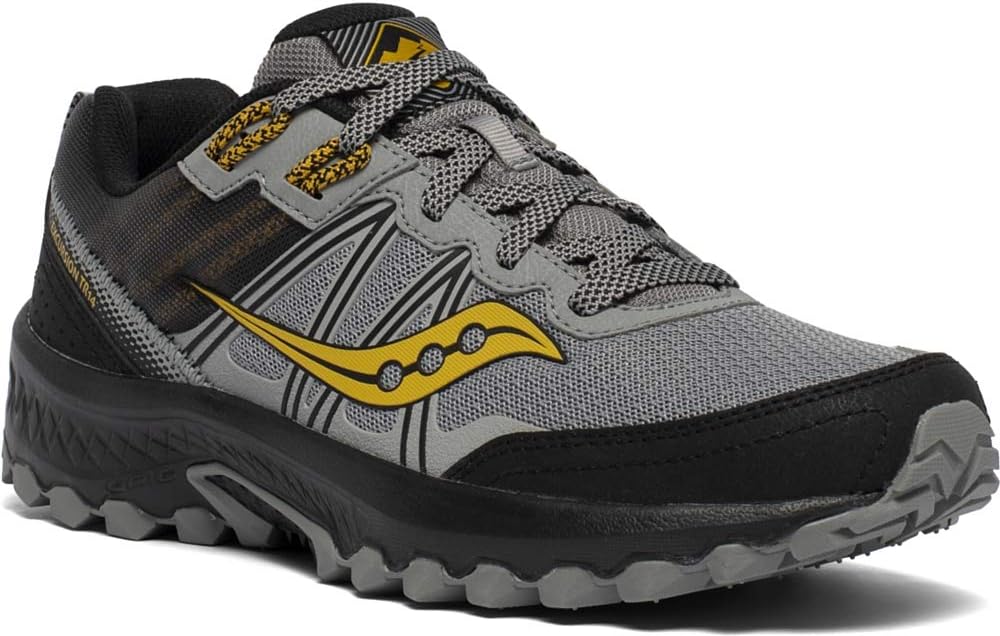
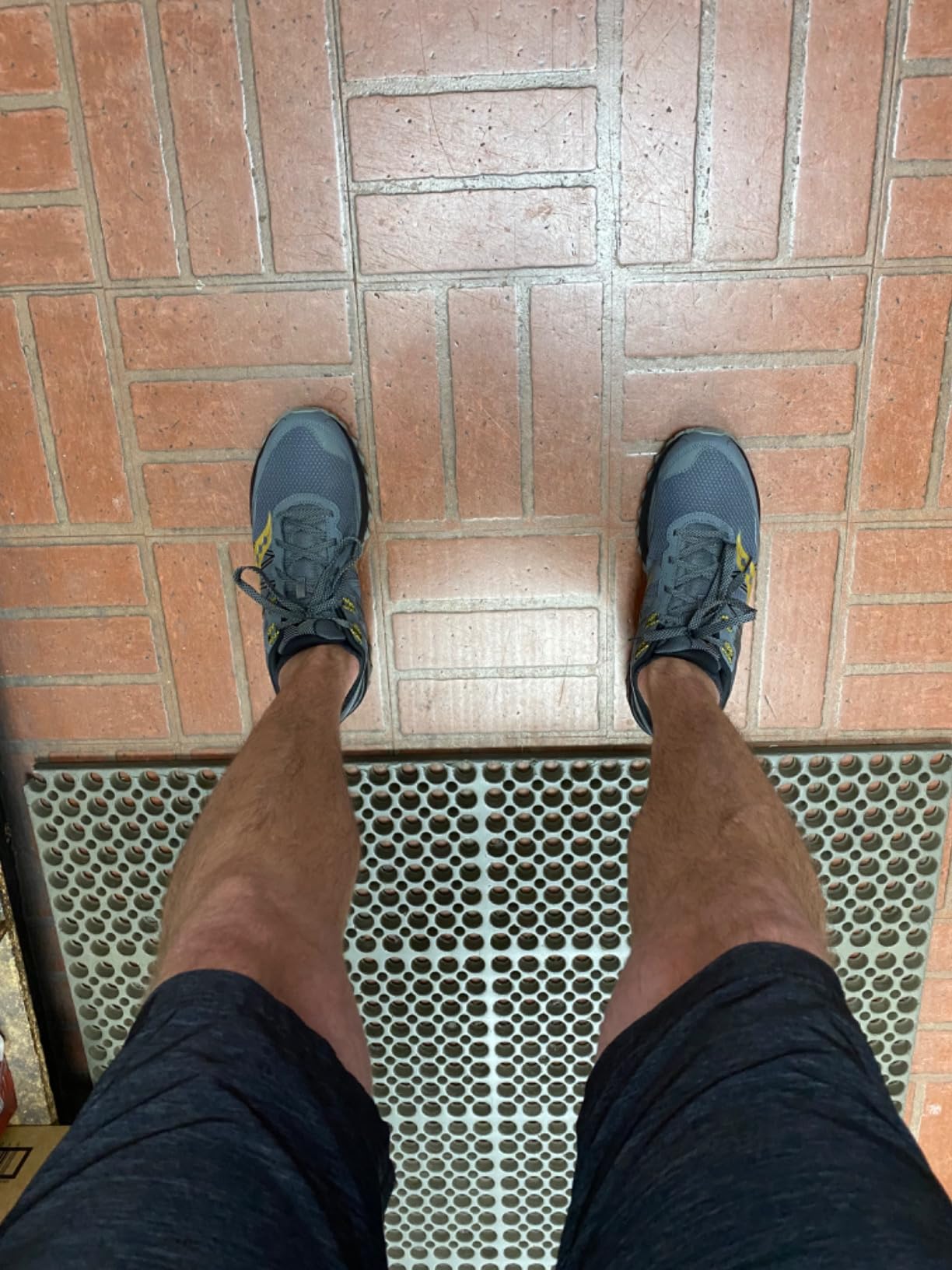
- Color tested: Grey/Gold (note: runs lighter in person than product photos)
- Upper: 100% synthetic mesh with supportive overlays
- Midsole: VERSARUN cushioning — moderate stack (~31mm heel / ~23mm forefoot, proxy from TR16 same line)
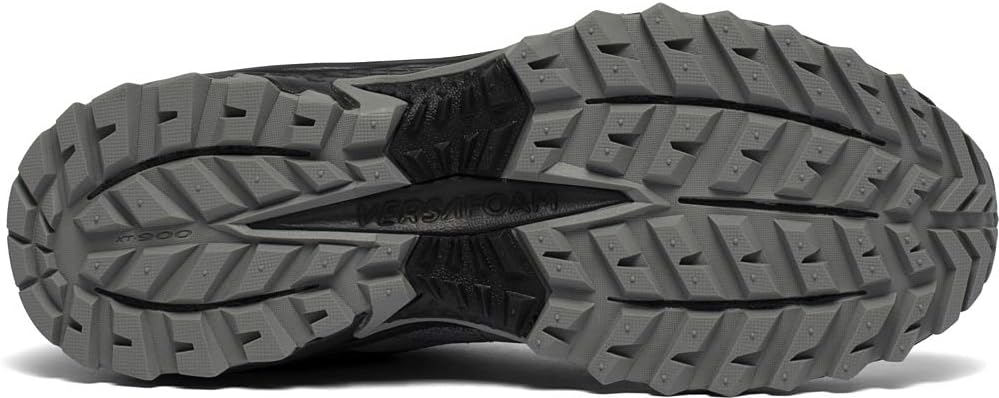
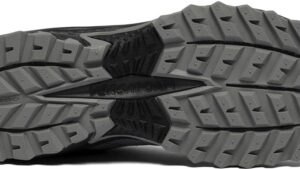
- Outsole: Carbon rubber lug pattern, ~4.5mm lug height
- Drop: ~8mm (proxy from TR16 GTX, same Excursion TR line)
- Weight: ~10.0oz / 286g men’s (proxy)
- Closure: Lace-up with orange paracord-style heel loops for rearfoot security
- Width: D (standard) and Wide options
- Price: ~$40–60 depending on colorway and size
First Look: Build and Materials
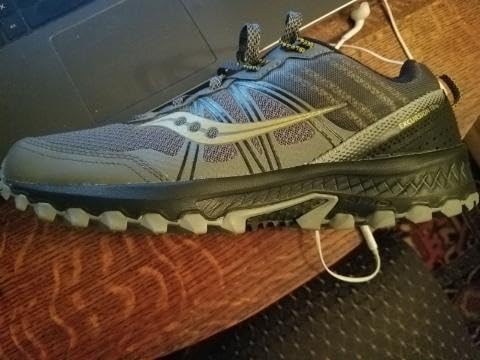
Pick up a pair of TR14s and the first thing you notice is how light they are — noticeably less than most hiking boots or chunky trail shoes. The mesh upper has a trail-specific weave, tighter than typical road shoe breathability mesh, with synthetic overlay panels stitched at the midfoot for lateral structure. It doesn’t feel flimsy. But it doesn’t feel bomber either, and that distinction will matter when we get to durability.
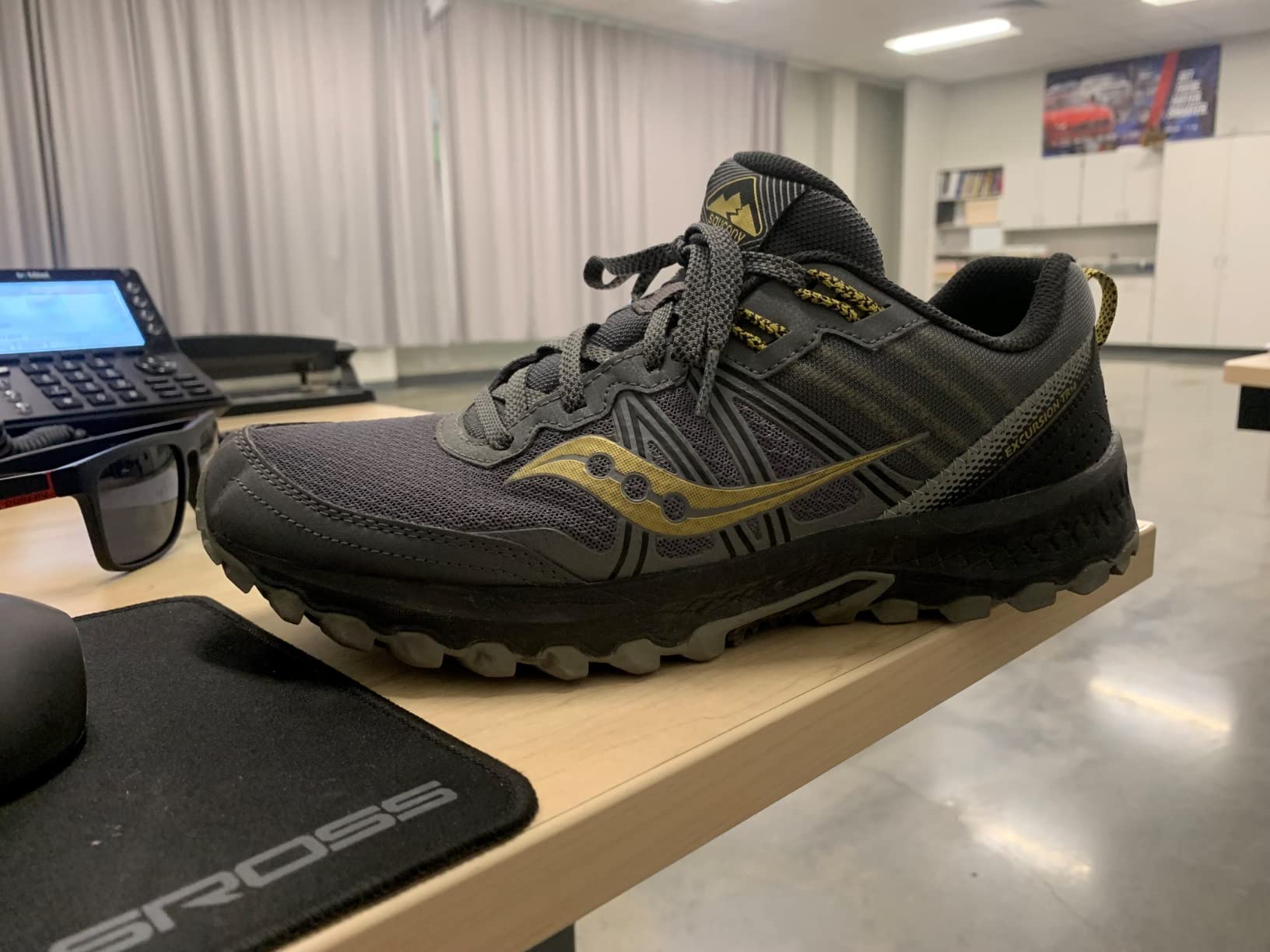
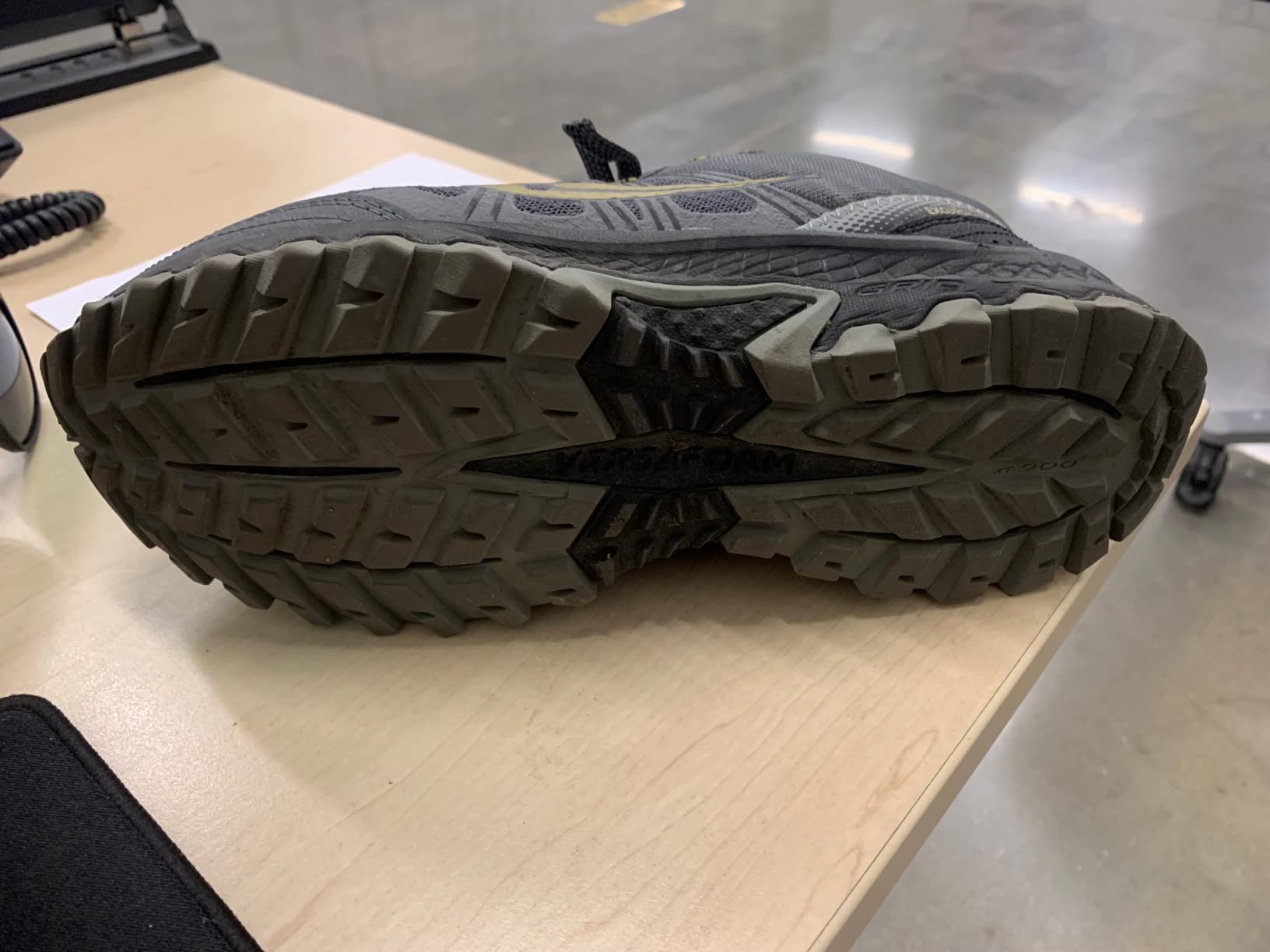
The lug pattern on the outsole is the visual highlight. Deep, multidirectional carbon rubber lugs — aggressive enough that you’d be wary wearing them in a nice hotel lobby, but exactly what you want when a forest path gets muddy after rain.
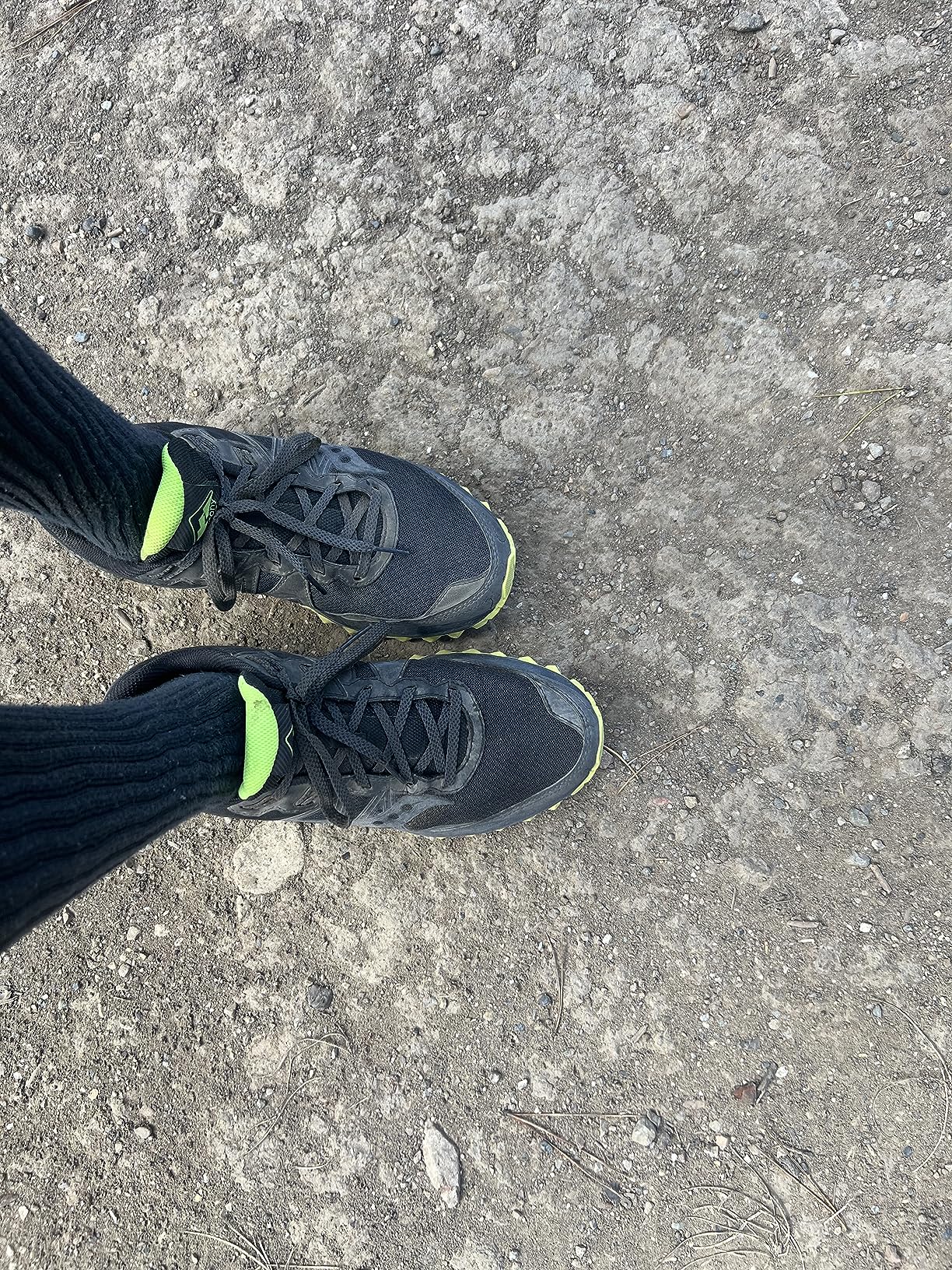
The detail that gets the most comment from buyers is the orange paracord-style lace loops near the top of the shoe. These aren’t just aesthetic — they route lace tension specifically toward the heel, which means better rearfoot capture on uneven ground. Several reviewers called this out as a thoughtful touch for sloppy terrain. The caveat: at least one buyer documented fraying of these loops around the 3–4 month mark. They’re not easily replaced, which means if yours fray, you’re either living with it or improvising. Smart design, durability asterisk.
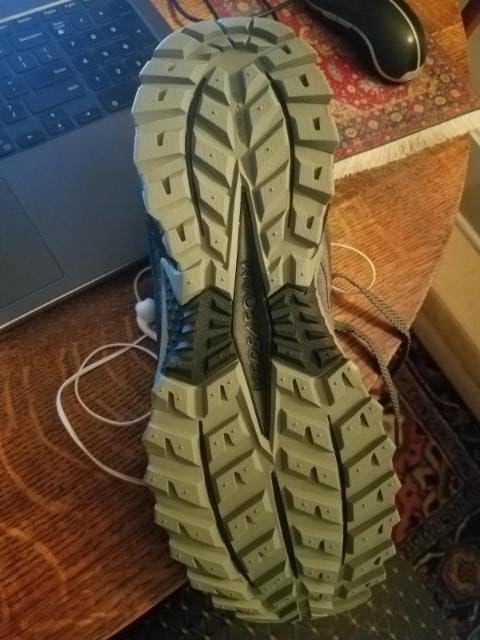
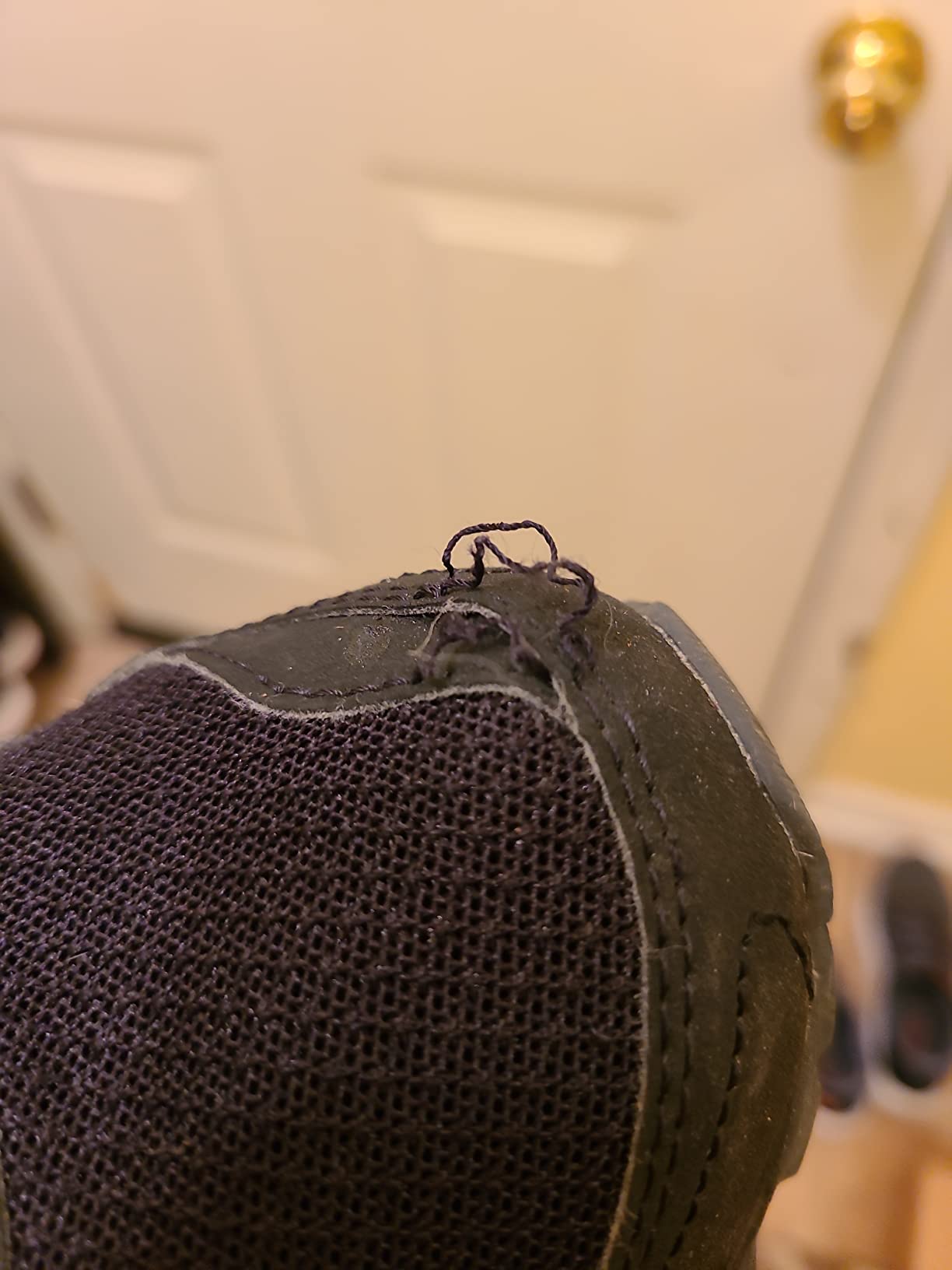
Stitching at the toe rand looks solid out of the box. Most buyers don’t see issues here. But there are documented cases — including a photo — of upper tears appearing as early as month one to three on some units. QC variance is real, and this is the section where you’ll want to buy from an authorized retailer rather than an unverified third-party seller.
Fit and Sizing — Where Things Get Complicated
For standard D-width feet, true to size is the call. The majority of buyers land on their normal size without issue, and the fit from lace-to-last feels accurate for average foot shapes. If you wear thicker socks for trail use, consider half a size up — this is a narrow-volume shoe, not a roomy one.
The Wide option is where it gets interesting. A solid chunk of broad-foot buyers found the Wide genuinely works: no blisters, no bruised toenails, good heel hold. But not everyone. A smaller group reports the Wide still pinches at the toe box. The honest takeaway here is that “Wide” in Excursion TR14 language is somewhere between standard D and true 2E — enough room for many, not enough for extreme-wide feet. If you’re on the wider end and already know narrow toe boxes cause problems for you, the TR14 in Wide is a “try before you commit” purchase.
| Foot Width | Size Recommendation | Notes |
|————|———————|——-|
| Narrow | Regular D, TTS or half-down | May be loose in heel; thin insole might help |
| Standard | Regular D, TTS | Sweet spot — consistent positive feedback |
| Wide | Wide option, TTS | ~70% success rate; some still find toe box narrow |
| Extra wide | Not recommended | No ultra-wide variant available |
The paracord heel loops do real work here. If your regular lacing feels like the heel isn’t captured enough, try cinching those top loops tighter before you write off the fit. Several buyers reported this made the difference between “flopping heel” and “locked in.”
One documented caution: thick aftermarket insoles can raise the heel enough to reduce the heel-cup capture. If you’re planning to run an arch insert, try a moderate-profile one rather than a high-volume orthotic — the heel geometry doesn’t have a lot of extra depth to accommodate it.
The Traction Story — What Everyone Agrees On
Trail grip on the TR14 has near-universal positive consensus. That’s not something you can say about cushioning or durability, so it’s worth sitting with: across dry hardpack, loose dirt, decomposed granite, damp forest paths, and even basic gravel commutes, buyers repeatedly describe the underfoot grip as confident and predictable.
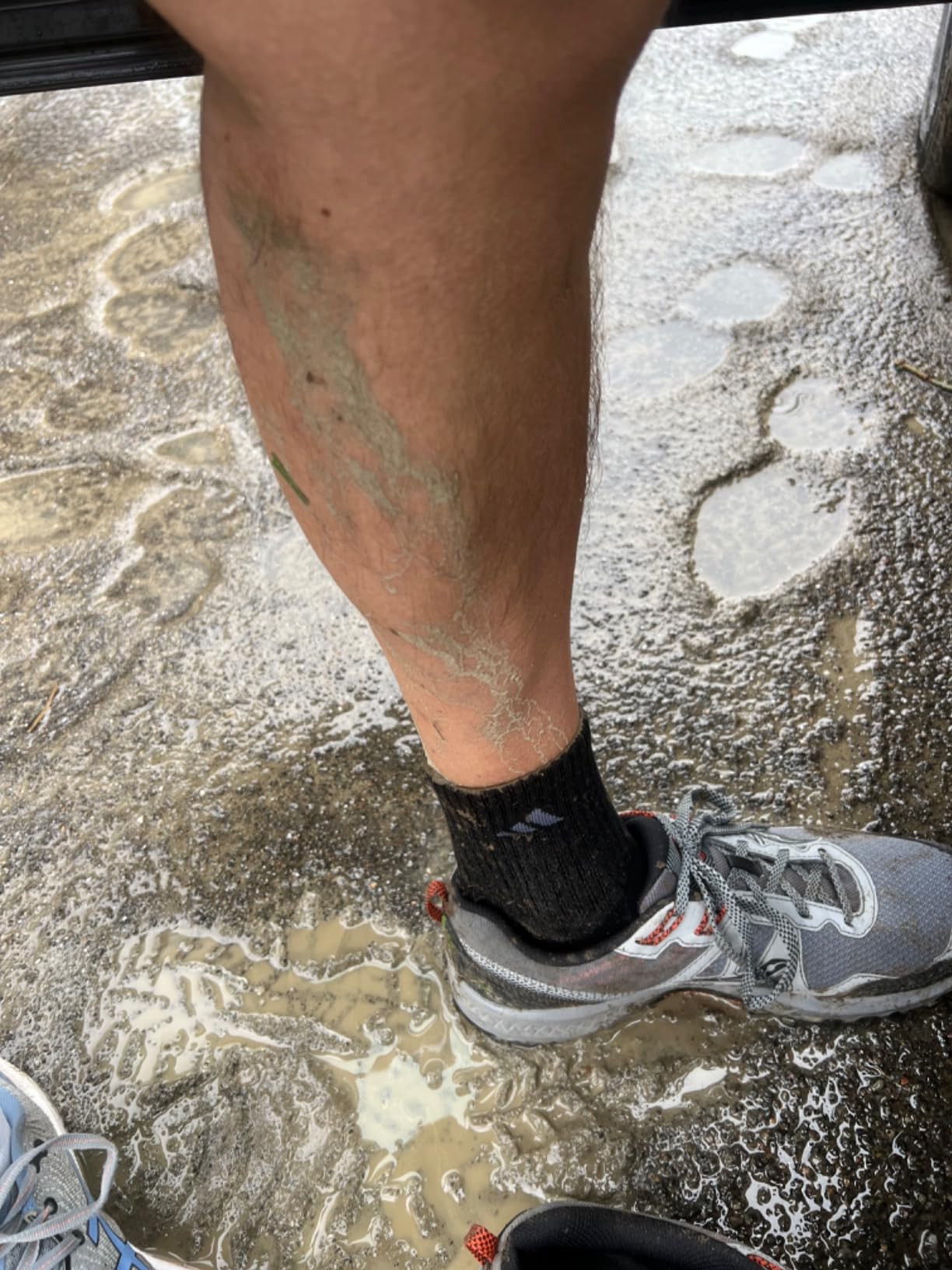
The carbon rubber compound grips without wearing down unusually fast on trail surfaces. Uphill traction gets specific praise — a few runners noted the lugs bite on ascents in a way that cheaper rubber doesn’t. Downhill confidence is mentioned almost as often. On moderate grades with loose dirt, the shoe feels planted rather than skating.
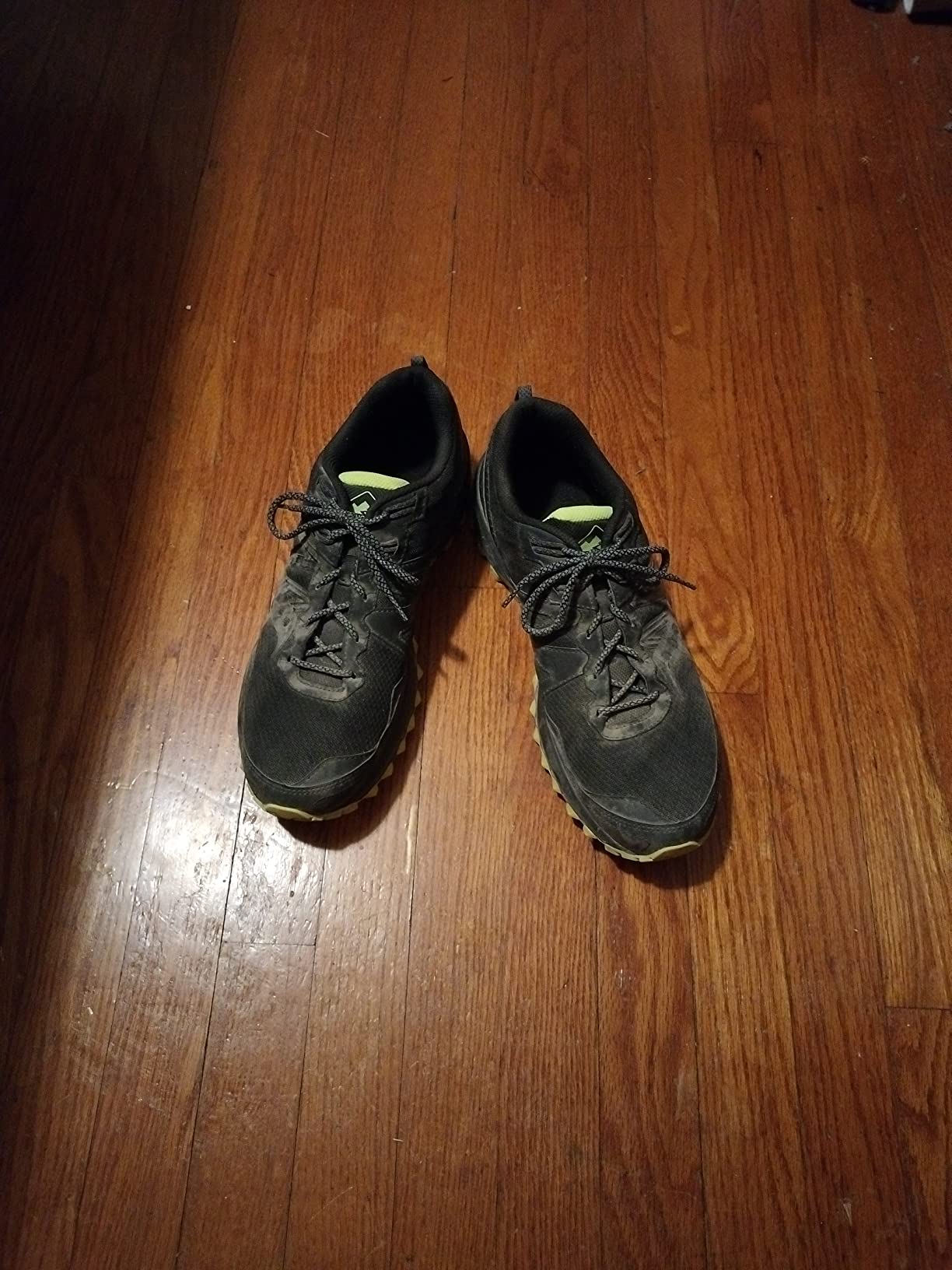
The exception is wet smooth surfaces. Indoor tile, polished concrete, gym floors — the aggressive lug pattern doesn’t have the siping that road surfaces and wet tile need. At least one buyer reported a near-slip on wet grocery store flooring. This isn’t a defect; it’s exactly what happens when you put a trail lug on a non-trail surface. If your daily context involves moving between outdoor trails and slick indoor floors, be deliberate about it.
| Terrain | Performance | Notes |
|———|————-|——-|
| Dry hardpack / desert dirt | Excellent | Consistent grip; precise braking on descents |
| Loose gravel / decomposed granite | Excellent | Lugs bite effectively |
| Damp forest paths | Good | Secure until very muddy |
| Deep mud | Moderate | Packs up; trail lug limit |
| City pavement | Good | Comfortable; expect faster lug wear |
| Wet smooth tile | Poor | Aggressive lugs without siping = slip risk |
Cushioning — “Essential” Means What, Exactly?
VERSARUN is Saucony’s mid-tier cushioning system — not their performance foam, not their budget cut, somewhere in the working-shoe middle. With ~31mm at the heel and ~23mm at the forefoot (based on TR16 proxy specs from the same line), it’s a moderate stack that prioritizes ground feel over plushness.
Walkers who transitioned from road shoes to trail found the firmness a reasonable trade-off for the grip. Mail carriers putting in 40+ miles a week on mixed pavement and trails called it comfortable enough for full-day shifts. That’s a meaningful vote of confidence for a $50 shoe.
Runners expecting road-trainer softness were often surprised. Multiple buyers compared the feel unfavorably to the Brooks Glycerin — which sits at 3× the price and uses a completely different foam compound. That comparison is apples-to-watermelons, but it tells you what buyers were expecting when they felt “minimal” underfoot protection. If your reference point for comfort is a max-cushion road shoe, the TR14 will feel jarring on pavement miles.
On rocky terrain — loose scree, talus, root-dense trails — at least one buyer described feeling individual rocks through the platform. The 8mm drop and moderate stack don’t provide the rigid rock plate that technical trail shoes use. If your regular route includes sustained rocky sections, you’ll notice this limitation.
Aftermarket insoles do help for many buyers, particularly those with high arches or plantar fascia sensitivity. Sof Sole Athlete Insoles or Valsole Orthotic Insoles both work well here — just keep in mind the heel-cup caveat from the fit section.
Durability — The QC Lottery
This is the section that genuinely splits buyers, and it’s worth being clear: the TR14 *can* be durable, but it’s not consistently durable.
The high end: some buyers logged 800–900 miles across multiple pairs, re-ordered regularly, and reported nothing more than expected lug wear and a slightly compressed midsole. Mail carriers wore them into the ground at 40+ miles per week and came back for seconds. That’s real durability at a $50 price point.
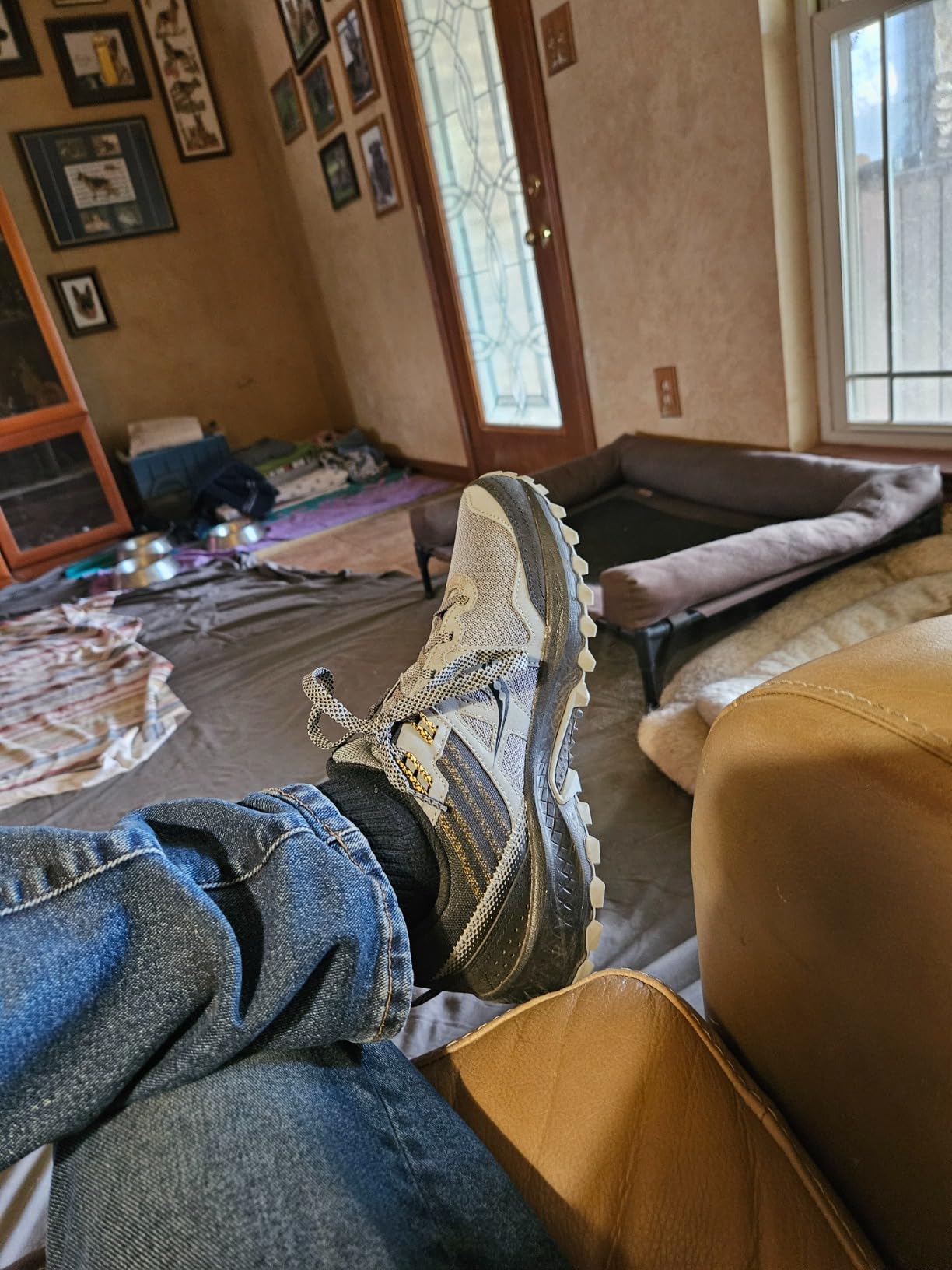
The low end: documented early failures include fraying paracord loops (month 3–4), toe box stitching coming apart (month 2–4), and upper material tearing near the toe rand (as early as month 1–3). These aren’t majority cases, but they’re not isolated either. The QC variability seems batch-dependent — a common pattern with budget shoes produced across multiple factories.
Pavement use accelerates lug wear more than trail use. The carbon rubber holds up on dirt, but sustained pavement miles — commuters, dog walkers on city routes — will smooth the lugs faster than trail rotation. Expect 6–9 months of decent traction on a mixed pavement/trail diet.
| Use Intensity | Expected Lifespan | Notes |
|—————|——————-|——-|
| Light (2–3×/week, trails) | 12–18 months | Lugs last; midsole stays functional |
| Regular (daily, mixed surfaces) | 6–9 months | Pavement accelerates lug wear |
| Heavy daily (40+ mi/week) | 3–6 months | Mail carrier pace; re-buy cycle confirmed |
The CamoGuys TR15 section (newer version) specifically called out quality concerns with unauthorized Amazon sellers — inferior insoles and increased failure rates. The same logic likely applies to TR14. Buy from Saucony’s site, from major running retailers, or from Amazon sold-by-Saucony listings rather than third-party re-sellers.
Versatility in Practice — Where This Shoe Actually Shows Up
Buyer use cases for the TR14 read like a list of “things you’d bring one versatile shoe to.” Not specialized enough for any single use case, but capable enough for most of them:
– **Mail carriers, 40+ miles/week:** Confirmed multiple buyers; breathability and traction work for the job
– **Spartan race obstacle courses:** Several buyers used them specifically for mud runs and kept them as gym/yard shoes afterward
– **European travel, 8–10 miles/day:** Packable weight, trail-meets-city versatility — one buyer specifically mentioned logging this mileage without foot issues
– **Yard work and ladders:** The lug pattern grips on uneven outdoor surfaces, and the protective overlay structure handles rough terrain better than road shoes
– **Dog walking, casual trail runs:** The primary sweet spot — 3–5 mile loops on park trails and neighborhood routes
What it doesn’t do: sustained rocky technical trails, high-speed road running, formal or business-casual contexts. The hiking shoe category has better options if your regular terrain involves sustained scrambling.
How It Compares
Three natural comparison points come up repeatedly in buyer discussions:
**TR15 / TR16 (same line, newer versions):** The TR15 and TR16 maintain the same DNA — VERSARUN cushioning, carbon rubber lugs, mesh upper. TR16 marketing uses “springier” language, though whether the midsole compound actually changed is unclear. If you’ve worn TR14 and want the same fit with potential minor improvements, TR15/TR16 is the logical upgrade path. Price step-up: $60–75 estimated for TR16 vs. $40–60 for TR14.
**Brooks Glycerin:** The cushioning benchmark buyers compare against. At 3× the price, with DNA LOFT V3 foam vs. VERSARUN, the Glycerin is a completely different comfort proposition — plush, road-optimized, heavier, and not designed for trail use. If you want that softness on road, get the Glycerin. If you’re on trails, they’re different tools entirely.
**Merrell Moab 2 Vent Mid:** The hiking boot comparison. Heavier (~11.5oz), more expensive ($100–130), with better ankle coverage, more midsole protection on rocky terrain, and stronger durability track record. The TR14 feels lighter and more flexible — good for walking distances, less good for technical climbing. If technical terrain is your primary use case, the Moab 2 is the better tool.
**Altra Lone Peak 8:** For wide-foot trail runners specifically, the Lone Peak offers a true foot-shaped toe box, zero drop, and a certified wider platform. At ~$130–140, it’s more than double the TR14’s cost, but for extreme-wide feet who keep striking out on the TR14’s Wide option, it’s worth the gap.
**ASICS Gel-Venture 10:** Direct budget trail competitor. Similar price range (~$55–65), GEL technology at the heel for slightly better cushioning on rocky impact, but slightly less aggressive lug pattern. If cushioning matters more to you than grip aggression, the Gel-Venture 10 is worth a look.
| | TR14 | Brooks Glycerin | Merrell Moab 2 | ASICS Gel-Venture 10 |
|–|——|—————–|—————-|———————-|
| **Price** | $40–60 | $140–160 | $100–130 | $55–65 |
| **Weight** | ~10oz | ~10.5oz | ~11.5oz | ~10.5oz |
| **Drop** | ~8mm | ~12mm | ~8mm | ~8mm |
| **Cushioning** | Moderate-firm | Very plush | Moderate | Moderate (GEL heel) |
| **Trail grip** | 8.6/10 | Road-optimized | 8.0/10 | 7.5/10 |
| **Wide option** | Yes | Yes | Yes | Yes |
| **Best use** | Light trail + walking | Road running | Technical hiking | Light trail + walking |
Score Breakdown
| Category | Score | Why |
|---|---|---|
| Traction | 8.6 | Near-universal grip praise on natural surfaces; wet tile slip is expected, not a defect. |
| Cushioning | 6.0 | VERSARUN delivers essential support; walkers fine; runners expecting road-shoe plush will be disappointed. |
| Stability / Support | 7.5 | Paracord heel loops genuinely aid lockdown; neutral support adequate for mixed-use; no rock plate for technical terrain. |
| Fit | 7.0 | D-width TTS works well for most; Wide option helps many but not all broad-foot buyers; toe box polarization is real. |
| Breathability | 7.7 | Trail-specific mesh stays reasonably airy even on high-mileage daily use; dries quickly. |
| Durability | 6.5 | Capable of 800+ miles on good units; documented early failures on others — batch QC is the variable. |
| Style | 7.2 | Functional trail aesthetic; nothing flashy; grey runs lighter in-person than photos. |
| Value | 9.0 | At $40–60, the traction-to-dollar ratio is hard to beat; buyers regularly rebuy multiple pairs. |
| Overall | 7.6 | Traction (8.6) and value (9.0) carry it; cushioning (6.0) and durability variability (6.5) bring it back to earth. |
Who Should (and Shouldn’t) Buy This
Best For
- Daily walkers and commuters who need breathable, grippy shoes that handle trail dirt and city pavement — the TR14’s versatility is its actual strength.
- Casual trail runners doing 3–5 miles on non-technical paths — groomed trails, park routes, forest service roads.
- Budget-minded buyers who can accept QC variability in exchange for $40–60 pricing and easy rebuy cycles.
- Wide-foot buyers who struggle to find Wide sizing in stock — the Wide option covers a meaningful portion of broader feet.
- Multi-use travelers who need one shoe for trails, city walking, and casual days.
Not Ideal For
- Rocky technical trails (scree, talus, root-dense terrain) — the TR14 lacks the rock plate protection that serious off-trail use demands.
- Runners expecting plush road-shoe comfort — if your baseline is the Brooks Launch 10 or similar, the VERSARUN firmness will be a letdown on longer runs.
- Heavy-pavement daily drivers — lugs wear faster on concrete; midsole will feel compressed sooner; expect shorter lifespan.
- Buyers needing guaranteed durability — QC lottery means some pairs outlast expectations, others don’t. If reliability is non-negotiable, step up to a shoe with a tighter QC track record.
- Wet-surface work environments — gyms, kitchens, wet floors — the trail lugs are a liability indoors.
If you want to step up in the Saucony trail line, the Saucony Endorphin Edge brings PWRRUN HG foam and a rock plate for technical terrain at a significant price jump. For budget hiking shoe alternatives, the NORTIV 8 Men’s Hiking Shoes and Merrell Accentor 3 offer more hiking-specific protection at comparable or moderate price points.
Frequently Asked Questions
Does the Excursion TR14 run true to size?
For standard D-width feet, yes — true to size is the consistent recommendation. If you’re between sizes, half a size up prevents toe-box crowding on downhills. Wide buyers should try the Wide variant at TTS first; about 70% find it works, but some still find the toe box narrow.
How does the cushioning compare to regular road running shoes?
VERSARUN is noticeably firmer than plush road trainers. Think of it as “enough for a 5-mile trail jog or a full day of walking” rather than “bouncy and forgiving on long pavement miles.” If your comparison point is the Brooks Glycerin, you’ll feel the difference on the first step. Walkers typically adapt well; road runners who want similar cushioning should look elsewhere.
Is it good on rocky technical trails?
On groomed trails and packed dirt, yes — very good. On loose scree, talus, or sustained rock gardens, at least one buyer described feeling individual rocks through the midsole. The TR14 lacks a rock plate. For technical terrain, something like the ASICS Gel-Venture 10 or a purpose-built trail shoe with a rock plate is a better choice.
How durable is the TR14 really?
It depends which unit you get. Good pairs hit 800–900 miles; early-failure pairs show paracord fraying, toe stitching issues, or upper tears within 1–3 months. Buying from an authorized retailer versus an unverified Amazon third-party seller is the best available risk reduction. Expect 6–9 months with regular mixed-use; 12–18 months with light use; 3–6 months with heavy daily driving.
Why does it slip on wet floors?
Trail lug design. Aggressive lugs without siping — the channels that help road rubber and indoor shoes grip smooth wet surfaces — are optimized for dirt, not tile. This is the expected trade-off for any trail outsole. It’s not something you can break in out of; it’s a permanent characteristic of the rubber compound.
Can I use aftermarket insoles?
Yes, and many buyers do — especially high-arch and plantar fasciitis sufferers. The stock insole is removable. The caveat: thick-profile orthotics can raise the heel enough to reduce heel-cup capture. Test your insole’s volume tolerance first; medium-profile arch support works better in this shoe than thick stackable orthotics.
How does the TR14 compare to the TR15 and TR16?
Same DNA — VERSARUN, carbon rubber lugs, mesh upper. TR16 marketing describes “springier” cushioning, though spec-level confirmation is limited. TR15 is the bridge version. If you’ve worn TR14 and want the same feel with potential small improvements, TR15/TR16 is logical. The TR14 now often appears at clearance pricing; TR16 sits at $60–75 estimated. The fit and general performance should translate between versions.
Is the Wide option genuinely wide, or just labeled wide?
Wider than standard D, but not equivalent to true 2E. It works well for many broader-foot buyers — those who bruise toenails in standard D found relief in Wide. But for feet that consistently require true 2E or 4E sizing, the Wide variant still runs tight at the toe box. If standard wide-fitting shoes like the Altra Lone Peak are in your rotation, the TR14 Wide may still feel narrow by comparison.
Be the first to review “Saucony Men’s Excursion Tr14 Trail Running Shoes”
Related products
Running Shoes

Running Shoes
Hiking/Trekking Shoes

Running Shoes
Running Shoes
Running Shoes

Running Shoes
Running Shoes
Reviews
There are no reviews yet.